After Certification: How MNOs Can Monetise Network APIs
 by
by
GMS Team
Network API certification is an important milestone, but it is not the finish line. It proves that an operator can expose network capabilities in a standardised, interoperable way. It does not prove that enterprises know why they should buy, that developers can onboard easily, that sales teams can qualify demand, or that the API will become recurring revenue.
That distinction matters because Network APIs are moving from industry ambition into commercial execution. GSMA Open Gateway and CAMARA have helped create a common technical foundation for exposing network capabilities through standardised APIs. But the commercial question comes next: once the API is certified, how do operators monetise Network APIs in a way that creates enterprise demand, a qualified pipeline, production deployments, and repeat usage?
Certification creates trust. It does not create a market
Certification solves a real problem. Enterprises and developers do not want every operator integration to look different. They want APIs that behave consistently across networks, countries, and partners. Standardisation makes it easier for enterprises to adopt Network APIs at scale. GSMA defines Open Gateway Certification as a structured testing programme that helps ensure operators and API providers deploy standardised APIs compliant with CAMARA specifications.
But interoperability is only one part of adoption. Enterprises rarely wake up looking for “a certified telco API.” They look for ways to reduce fraud, improve authentication, increase transaction completion rates, optimise the customer experience, comply with regulations, or automate operations.
That means MNOs need to stop thinking of Network APIs as technical endpoints and start managing them as commercial products. A certified SIM Swap API is not just a telco capability. For a bank, it is an account takeover prevention tool. A Number Verification API is not simply an authentication interface. For a marketplace, fintech, or e-commerce company, this is a way to reduce OTP friction and improve conversion rates. A Quality on Demand API is not merely network exposure. For gaming, video, healthcare, or industrial applications, it provides a predictable user experience when latency, jitter, or throughput matters.
This is the foundation of network API monetisation for operators: translating network capabilities into business outcomes that enterprises already understand, budget for, and measure.

The “dumb pipe” risk is repeating itself
Operators have seen this movie before. SMS became an essential infrastructure for authentication, alerts, marketing, and customer engagement, yet much of the enterprise relationship shifted to aggregators, CPaaS providers, SaaS platforms, and digital channels. Mobile data became the foundation for the app economy, but many of the highest-margin digital services were captured above the connectivity layer.
Network APIs are an opportunity to change that pattern. They allow MNOs to expose differentiated network intelligence, security, identity, location, quality, and device capabilities directly into enterprise workflows and user journeys.
As David Vigar, Head of Innovation and Product at GMS, pointed out in the recent CPaaS Acceleration Alliance interview: "Many of the Network APIs are layering additional data points that help... make those operations more secure, help identify if this is the right person that I want to be interacting with".
But this only happens if operators package, price, sell, and support them around the value enterprises receive. The risk is not that enterprises reject Network APIs. The risk is that enterprises adopt them through someone else’s commercial layer while operators remain invisible as suppliers of raw capability. If MNOs expose APIs but fail to own product design, enterprise discovery, onboarding, commercial packaging, and usage expansion, they may simply recreate the wholesale model in a new technical format.
That is why the question of how to monetise Network APIs cannot be answered by certification alone. Monetisation depends on whether operators can build a commercial route to market around the APIs, not just expose them.
Enterprise demand starts with use cases, not API catalogues
GSMA Intelligence’s Network API Demand Index: a vertical-sector view makes this point commercially clear. It states that monetisation is the key objective for telcos and distribution partners, and that the go-to-market strategy must vary by API and buyer. In other words, MNOs should not treat all certified APIs as equal. They should prioritise the APIs and verticals where demand, urgency, willingness to pay, and deployment feasibility are strongest.
Instead of asking, “Which APIs have we certified?” operators should ask:
Which industries have urgent problems this API can solve?
Which enterprises already spend money on imperfect alternatives?
Where can network data or network control create measurable uplift?
Which use cases can move from pilot to production within one budget cycle?
Which channel partners already sell into those accounts?
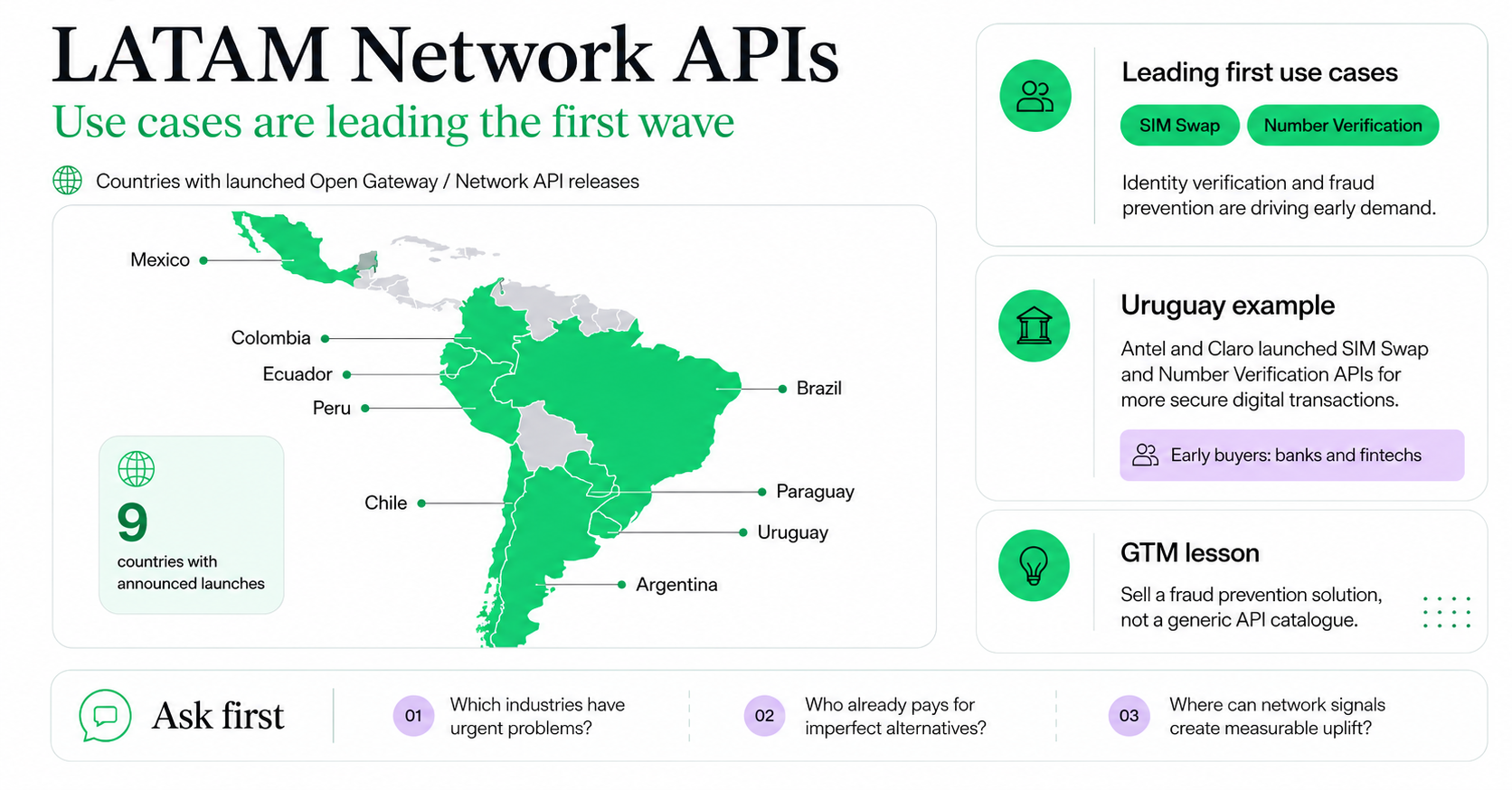
This use-case-first logic is already visible in Latin America. In Uruguay, Antel and Claro launched their first two solutions under GSMA Open Gateway around SIM Swap and Number Verification, positioning them specifically as tools for identity verification and fraud prevention rather than simply as new network capabilities. SIM Swap can identify recent changes to the SIM associated with a mobile number, while Number Verification can confirm the relationship between a phone number and the device initiating an interaction. Banks and fintechs are among the first potential customers identified for these services, illustrating how an operator can start with a high-value enterprise problem—digital transaction fraud—and then assemble the APIs needed to address it.
That is an important GTM lesson for network API monetisation more broadly. The commercial proposition in Uruguay is not simply “we have Open Gateway APIs.” It is closer to “we can help financial institutions make digital transactions more secure using network-backed identity signals.” As Open Gateway expands across Latin America, this problem-led approach gives operators a clearer route from API certification to enterprise adoption.
This changes the GTM motion. A bank fraud team does not need a generic Network API brochure. It needs a fraud prevention package with SIM Swap, Number Verification, device status, risk signals, service levels, compliance language, integration guides, and ROI assumptions. A gaming company does not need a telecom standards overview. It needs a performance assurance package that explains when Quality on Demand is triggered, how sessions are charged, how latency improvements are measured, and how the API fits into the game engine or cloud architecture.
This is especially important for network API monetisation in 5G, where APIs such as Quality on Demand, device location, edge discovery, and network slicing-related capabilities can support enterprise use cases that require more than basic connectivity.
Productisation is where certification becomes revenue
Certified APIs need commercial product wrappers. Without them, they remain technical assets waiting for demand. Productisation should cover at least five layers.
-
First, features. Enterprises need more than an endpoint. They need sandbox access, SDKs, reporting, error handling, consent flows, dashboards, alerts, support, and clear SLAs. They also need predictable behaviour across operators and markets.
-
Second, packaging. A single API may be useful, but enterprise value often comes from bundles. Fraud prevention may combine SIM Swap, Number Verification, KYC Match, Device Reachability, and risk scoring. Customer experience may combine Quality on Demand, location verification, connectivity insights, and edge discovery. IoT operations may combine device reachability, roaming status, and device data volume.
-
Third, pricing. Per-call pricing is simple, but it does not always map to value. MNOs should consider pricing models such as per-verification, per-protected-transaction, per-active-user, per-Quality-on-Demand-session, per-enterprise-account, committed monthly usage, revenue share, or tiered bundles by SLA and geography. The more directly pricing follows enterprise value, the easier it becomes to defend margin.
-
Fourth, onboarding. Developer experience determines whether interest becomes usage. Enterprises should be able to discover the API, understand the use case, test in a sandbox, estimate cost, clear legal and compliance requirements, move to production, and monitor performance without months of manual coordination.
-
Fifth, commercial operations. Recurring API revenue requires rating, billing, settlement, partner management, usage analytics, support workflows, fraud controls, and customer success. Operators that are serious about monetising Network APIs need an operational stack to manage the full lifecycle, from lead generation to live consumption and expansion.
Channel strategy: direct, partner-led, or hybrid?
MNOs do not need to choose between selling directly and working with partners. They need to decide which motion fits each API and buyer segment.
For strategic enterprise accounts, direct selling makes sense. Banks, hyperscalers, national retailers, healthcare networks, and government platforms may require direct commercial, regulatory, and technical engagement with the operator. These customers often care about trust, compliance, local market coverage, and operational accountability.
For developer-scale adoption, channel partners are essential. CPaaS providers, aggregators, cloud marketplaces, system integrators, fraud platforms, and SaaS vendors already own many enterprise workflows. GSMA reported in March 2026 that 86 operator groups, representing more than 300 networks and 80% of global mobile connections, were aligned around a common API framework, with more than 60 channel partners commercialising Network APIs at scale.
The challenge is to avoid becoming invisible. If channel partners own all packaging, customer data, pricing, and account relationships, operators may again be reduced to supply-side infrastructure. A better model is hybrid: partners accelerate distribution, but MNOs retain product intelligence, usage visibility, commercial governance, and strategic account ownership where needed.
This is where network API monetisation for MNOs and CSPs becomes a strategic operating model, not just a new revenue line. Operators must decide where they want to sit in the value chain: raw capability provider, wholesale API supplier, co-seller, marketplace owner, or enterprise solution partner.
Turning awareness into a qualified pipeline
The post-certification funnel should be intentionally designed. A practical Network API pipeline might look like this:
Awareness begins with vertical narratives, not standard language. For example: “reduce account takeover fraud,” “improve checkout conversion,” “guarantee video quality for premium users,” or “verify device location for logistics and insurance.”
Consideration begins when the enterprise sees a measurable business case. That requires ROI calculators, proof points, reference architectures, compliance notes, and benchmark assumptions.
Qualification begins when the operator can identify the budget owner, use case, target market, expected volume, integration owner, data/privacy requirements, and deployment timeline.
Pilot begins with a scoped integration, test accounts, success criteria, and usage-based evaluation.
Production begins when the API is embedded in a live enterprise workflow that includes billing, support, monitoring, and account management.
Expansion begins when the operator uses consumption data to identify new geographies, API bundles, additional departments, or partner integrations.
This is where MNOs need pipeline discipline. Certification answers, “Can the API work?” Commercial pipeline answers, “Who needs it, why now, what is the value, how will they buy, and how will usage grow?”
Build vs buy is no longer just an infrastructure question
Many operators frame the Network API decision as a choice between building the exposure layer internally and using an external platform. That is too narrow. The real question is whether the operator can build the full commercial route-to-market.
Building internally may offer control, brand ownership, and deeper integration with network systems. But the operator must also build developer experience, product packaging, billing, partner onboarding, marketplace distribution, enterprise sales enablement, usage analytics, settlement, compliance workflows, and customer success.
Buying or partnering can accelerate time to market, especially where a provider already has API management, onboarding, billing, routing, settlement, enterprise access, or CPaaS distribution. But operators should avoid outsourcing. The MNO still needs to define priority verticals, commercial rules, pricing logic, partner incentives, and the role of Network APIs in its broader enterprise portfolio.
The right question is not “Can we expose APIs?” It is “Can we repeatedly turn exposed APIs into enterprise revenue?” That is the real test of how to monetise Network APIs after certification.
Network intelligence has a potential to become a product
Network APIs are valuable because they expose capabilities that only operators can provide: real-time network status, subscriber context, device state, authentication signals, quality control, location insights, and connectivity intelligence. But value is only captured when these capabilities are translated into repeatable enterprise products.
That is the promise of monetising network intelligence. Instead of selling connectivity alone, operators can commercialise trusted network signals and controls that help enterprises make better decisions, reduce risk, improve experience, and automate digital services.
CAMARA’s 2025 meta release shows how quickly the technical foundation is expanding, with APIs covering areas such as Number Verification, SIM Swap, Quality on Demand, Simple Edge Discovery, and other network capabilities. But operators should not confuse a broader API catalogue with a stronger commercial proposition. The winning proposition is not “we have APIs.” It is “we can help you reduce fraud, improve experience, verify identity, optimise performance, or automate operations using trusted network intelligence.”
However, network intelligence must be packaged responsibly. Enterprises need clarity on consent, privacy, security, auditability, and regulatory boundaries. Operators that make these requirements easy to understand and easy to operationalise will have an advantage over those that treat compliance as an afterthought.
What successful MNOs will do differently
The operators that win in Network APIs will be those who build the clearest path from certified capability to enterprise adoption.
They will prioritise use cases with measurable enterprise pain. They will sell outcomes instead of endpoints. They will package APIs into vertical solutions. They will give developers a low-friction way to test and deploy. They will price around value rather than treating every API call as a commodity. They will use partners without surrendering all customer ownership. They will measure not only API availability, but API activation, conversion, retention, and expansion.
Most importantly, they will understand that certification is the start of commercialisation. The standard gets operators into the market. Product strategy, packaging, onboarding, sales motion, pricing, and customer success determine whether they stay there profitably.
Network APIs can help MNOs move beyond connectivity and reclaim a more strategic role in enterprise digital services. But that outcome is not automatic. It requires operators to behave less like infrastructure suppliers and more like product companies.
After certification, the real work begins: learning how to monetise Network APIs in a way that creates measurable value for enterprises and sustainable recurring revenue for operators.
GMS Team
Stay ahead of industry news
Join our newsletter community to receive the latest updates on industry trends, upcoming events and webinars, and the latest GMS product updates.
More from GMS
Keep up with industry trends and technology advancements.