Why Identity is Emerging as the First Big Commercial Use Case for Network APIs
 by
by
GMS Team
Network APIs have been discussed for years as a way for operators to expose valuable network capabilities to developers, enterprises, cloud platforms, and digital service providers. The promise is compelling: instead of treating the mobile network as a closed connectivity layer, operators can expose selected, secure, standardised capabilities through APIs that applications can use in real time.
But the commercial question is sharper than the technical one: which use case gets enterprises to buy first?
Identity may be the answer.
For mobile operators, identity is not an abstract digital service. It is already embedded in the network. Every day, operators manage the relationship between a subscriber, a mobile number, a SIM, a device, a network session, and a billing account. Those signals are highly relevant to enterprises trying to onboard users, verify accounts, approve transactions, detect fraud, and protect customers from account takeover.
That makes identity one of the most immediate commercial entry points for Network APIs. It solves problem enterprises already understand, addresses fraud and conversion losses they already measure, and builds directly on operator strengths.
From A2P SMS to network-based trust
For years, the most visible operator role in digital identity has been A2P SMS. Enterprises send one-time passwords, alerts, verification codes, and transaction messages to mobile users, often through SMS infrastructure and aggregators. Under the hood, much of this messaging ecosystem has historically relied on SMPP, an open industry standard for transferring short message data between message centres, such as SMSCs, and external application systems, such as gateways.
That business is still important, but identity Network APIs point to something broader. Operators are no longer just transporting a verification message. They can help answer trust questions before, during, and after authentication:
-
Is this the phone number actually used on the device?
-
Has the SIM recently changed?
-
Does the customer-provided name, address, or date of birth match operator-held records?
-
Is the device or number showing risky changes?
-
Should a transaction be stepped up, delayed, or blocked?
This is a shift from message delivery to risk intelligence. It gives operators a more strategic role in the authentication and verification stack.
Why is identity commercially ready?
Identity stands out because enterprise demand is already mature. Banks, fintechs, insurers, marketplaces, e-commerce platforms, gig economy apps, social platforms, and digital wallets all need better ways to reduce fraud without adding friction.
The pain is immediate. Passwords are weak. SMS OTP is familiar but vulnerable to interception, phishing, social engineering, and SIM swap attacks. Device fingerprinting can be opaque and inconsistent. Document-based identity verification is useful but expensive and too heavy for every login or transaction. Enterprises need additional signals that are real-time, low-friction, and difficult for fraudsters to fake.
This is where the mobile network has natural value. Network-based identity signals can support several stages of the customer lifecycle: onboarding, account recovery, login, transaction approval, fraud monitoring, and account protection.
As Elliot Rose, Market Intelligence Manager at GMS, puts it:
"For now, operators continue to favour transactional, per-check pricing because it is familiar and commercially safe. But that approach is already becoming more nuanced. In some cases, especially when APIs such as SIM Swap and Number Verification are bundled, pricing is tied more closely to the verification event itself than to the raw number of API calls. That is where value becomes clearer, and where providers can better demonstrate their role".
The commercial message for operators should therefore be simple: we are not just selling generic Network APIs; we are helping enterprises verify users, reduce fraud, and approve trusted digital interactions.
The identity APIs toolkit
The first wave of commercially relevant identity APIs is already visible in the CAMARA and GSMA Open Gateway ecosystem. CAMARA lists mature APIs under “Authentication and Fraud Prevention,” including Number Verification, SIM Swap, KYC Match, KYC Age Verification, KYC Tenure, One Time Password SMS, Device Swap, Number Recycling, and Scam Signal.
Number Verification is one of the clearest starting points. It allows an application to verify whether the phone number a user declares matches the number associated with the authenticated device or access token.
SIM Swap is another high-value signal. The CAMARA SIM Swap API is designed to detect changes in the SIM card associated with a mobile number and can return a timestamp, a yes/no result for a defined period, or real-time notifications through a subscription model. CAMARA describes this as valuable for fraud prevention, account protection, and transaction validation.
KYC Match extends the value into onboarding and compliance. CAMARA describes it as the ability to compare the information the API customer has for a particular user with that on file by the user’s MNO in their own KYC records, with use cases like identity fraud and theft prevention, AML/KYC compliance, and higher-quality commercial experiences.
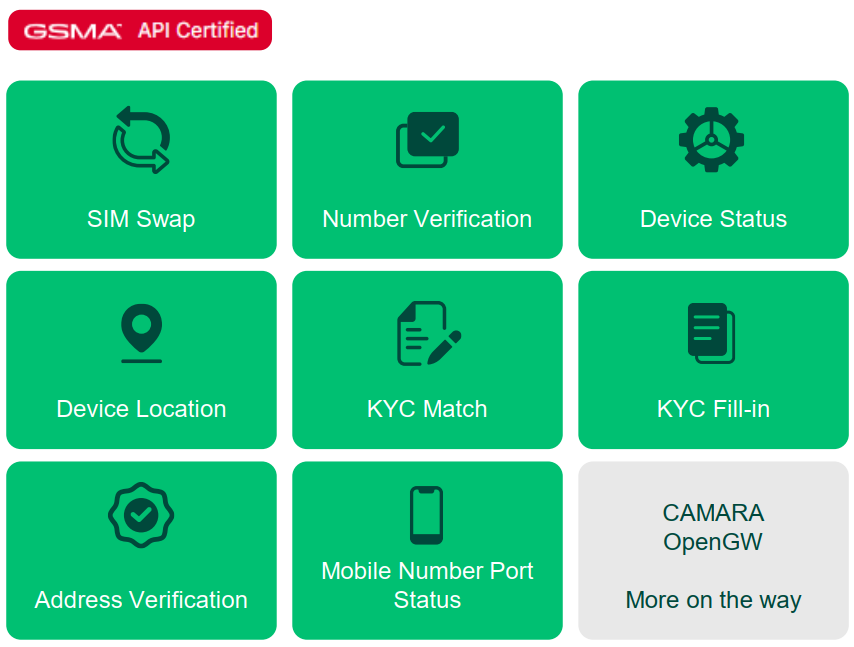
GMS Network APIs Toolkit
Together, these APIs give operators multiple ways to solve urgent enterprise problems. A bank might use SIM Swap before approving a high-risk transfer. A marketplace might use KYC Match during seller onboarding. A fintech app might use Number Verification to reduce fake account creation. An insurer might combine KYC Match, SIM Swap, and Location Verification to reduce identity theft during policy changes or claims.
The value is not in any single API alone. The value is in the identity decision layer of operators that can help power.
Why standards matter now
The biggest historical barrier to telecom APIs has been fragmentation. Enterprises do not want to integrate separately with every operator in every market. Developers want predictable interfaces, consistent authentication, clear documentation, and repeatable commercial models.
This is why the standards conversation matters. CAMARA is an open-source Linux Foundation project that defines, develops, and tests APIs in collaboration with the GSMA Operator Platform Group, with the goal of publishing aligned API definitions and developer-friendly documentation, while GSMA Open Gateway provides the broader commercial and ecosystem framework.
Certification is also important, as enterprises will not scale sensitive identity and fraud-prevention use cases unless they trust the API behaviour across markets and providers. This is the commercial unlock: standards make identity APIs easier to buy, integrate, test, and scale.
The Authentication Taskforce lesson
The industry has tried carrier-led identity before. In the US, the Mobile Authentication Taskforce, made up of AT&T, Sprint, T-Mobile, and Verizon, revealed details in 2018 for a carrier-network-powered authentication platform intended to protect enterprises and consumers from identity theft, bank fraud, fraudulent purchases, and data theft. It included network-verified mobile number, SIM card attributes, phone number tenure, account type, IP address, and risk analytics.
That earlier generation showed both the opportunity and the risk. The opportunity was clear: operators have unique identity and security signals. The risk was also clear: enterprises and consumers need transparency, consent, openness, and interoperability. Privacy advocates raised concerns about tying identity too closely to phone numbers and about the visibility carriers could gain into user logins.
The current Network API movement has a better chance because it is being built around standardisation, API exposure, consent management, and multi-operator interoperability rather than isolated national identity schemes. CAMARA’s Identity and Consent Management, working group (of which GMS is a member) focuses on privacy-by-default, consent capture, secure identity management, and standardised methods for API authentication and authorisation.
That is essential. Identity APIs will only scale if enterprises can trust the governance as much as the signal.
The commercial packaging opportunity for identity APIs
Operators should avoid positioning identity APIs as a catalogue of technical endpoints. Enterprise buyers do not wake up wanting “Number Verification API v1.0.” They want fewer fake accounts, fewer fraudulent transactions, reduced reliance on OTPs, faster onboarding, better compliance, and less customer friction.
The strongest commercial offers will be packaged around outcomes:
-
Onboarding assurance: Number Verification plus KYC Match to validate new users without heavy friction.
-
Account takeover protection: SIM Swap, Device Swap, Number Recycling, and risk signals before password reset or account recovery.
-
Transaction approval: SIM Swap and device/location signals to support real-time risk decisions for payments, transfers, and high-value changes.
-
Compliance support: KYC Match and age or tenure attributes for regulated industries.
-
Authentication enhancement: Number Verification and silent network-based checks to reduce reliance on SMS OTP where appropriate.
This is also where aggregators and channel partners matter. Most enterprises will not buy operator-by-operator. They will buy through CPaaS providers, fraud platforms, identity orchestration platforms, cloud marketplaces, and regional API hubs. Operators that make their APIs easy to consume through these channels will have a better chance of turning identity into recurring revenue.
Identity as the wedge for broader Network APIs
Identity could become the first major proof point for the wider Network API economy because it has three things many other APIs still need to prove: a clear buyer, a measurable pain point, and a familiar commercial path.
Once enterprises integrate identity APIs, it becomes easier to expand into adjacent capabilities. Fraud teams may add Location Verification. Customer experience teams may add Device Status or Device Reachability. Media, gaming, and financial apps may explore Quality on Demand. IoT providers may look at device and connectivity status. Over time, identity becomes the entry point into a broader programmable network relationship.
That matters for operators. The first Network API sale should not be treated as a one-off API transaction. It should be treated as the beginning of an enterprise trust layer.

Operators must start speaking the enterprise language
Operators should not lead with “we have Network APIs.” That is too broad. They should lead with a sharper commercial promise:
"We help enterprises verify customers, reduce fraud, and approve trusted digital interactions using secure, standardised network signals".
That message is easier for banks, fintechs, marketplaces, insurers, and digital platforms to understand. It also moves operators beyond the declining economics of simple message delivery and into higher-value security and trust services.
Identity is not the only Network API use case. Location, device information, quality on demand, edge, and network slicing all play a role. But identity may be the most commercially immediate because the problem is urgent, the data is native to the operator, and the value can be measured quickly.
If operators want Network APIs to move from industry narrative to revenue, they should start with identity.
GMS Team
Stay ahead of industry news
Join our newsletter community to receive the latest updates on industry trends, upcoming events and webinars, and the latest GMS product updates.
More from GMS
Keep up with industry trends and technology advancements.