GMS Talks at MWC 2026: Network API Monetisation, A2P Revenue, and Telco-Ready Voice AI
 by
by
GMS Team
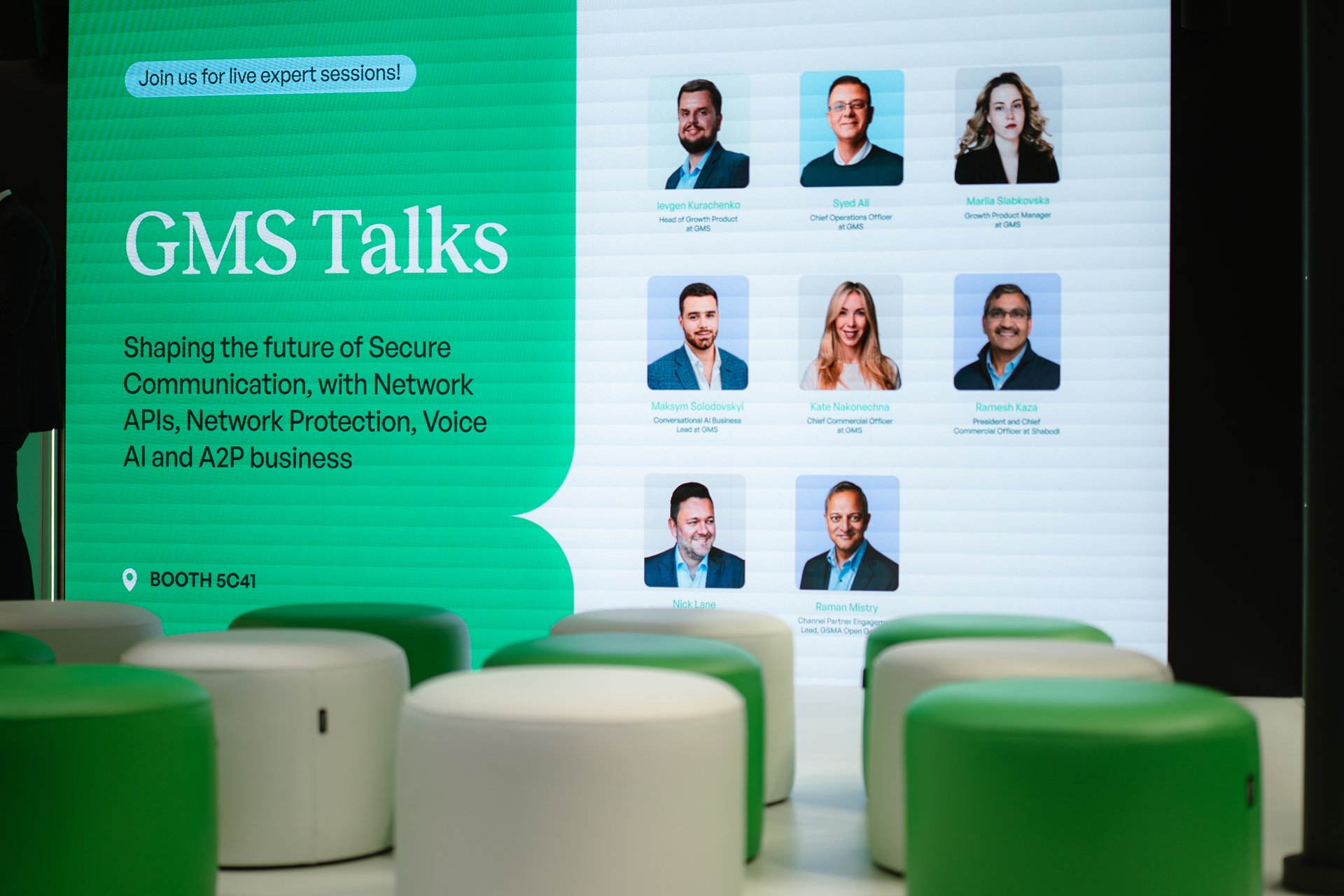
Mobile World Congress brings together telecom leaders to address the industry's biggest changes and challenges. At MWC 2026, GMS Talks delivered focused, practical conversations on the technologies and business models shaping communications — moving the industry toward actionable outcomes.
This year’s sessions focused on three closely connected themes: Network APIs monetisation, the future of A2P revenue models, and what it takes to make Voice AI truly telco-ready. Across the discussions, one message came through clearly: the next phase of telecom innovation will not be defined by technology alone, but by how effectively it is packaged, secured, monetised, and operationalised.
From fraud prevention and digital identity to premium connectivity experiences and AI designed for real telecom environments, the conversations at GMS Talks reflected an industry moving beyond experimentation toward practical execution.
Network APIs in 2026: from momentum to monetisation
One of the central topics at GMS Talks this year was the growing maturity of the Network APIs ecosystem. Just a few years after the industry began aligning around open, standardised network exposure, the conversation is now much more practical.
The question is no longer whether Network APIs matter. The question is how to turn them into solutions that operators, aggregators, and enterprises can actually monetise.
Together with partners from Shabodi and representatives from the wider Open Gateway ecosystem, GMS explored how the market has evolved from early standardisation efforts toward commercial packaging, partner collaboration, and the development of real-world use cases. The discussion made one point especially clear: enterprises do not buy APIs for their own sake. They buy solutions to business problems. At the same time, the conversation quickly moved from adoption to Network APIs monetisation, with a focus on how to turn capabilities into revenue-generating services.
That distinction matters. A single API signal may be technically impressive, but market value is created when multiple capabilities are combined into something usable, whether that is a transaction validation flow, an anti-fraud package, a verification service, or a premium connectivity offer embedded into an app experience.
For operators, this changes the commercial conversation. Network intelligence has always existed inside telecom infrastructure. What is changing now is the ability to expose it in a standardised, enterprise-ready format and package it into services that create measurable business value.
Fraud prevention and digital identity move to the network layer
A major use case discussed during GMS Talks was financial fraud prevention, particularly in scenarios involving high-value digital transactions.
Speakers described how banks continue to face growing fraud pressure despite years of investment in app security and SMS OTP-based authentication. The issue is no longer just message delivery. It is the broader question of whether the user, device, SIM, and transaction context can be trusted.
This is where Network APIs create a new layer of value. Operators hold a wide range of network signals: whether a SIM was recently swapped, a device changed, a number is behaving as expected, or the phone in use matches known patterns. When exposed through standardised APIs, this intelligence can strengthen verification flows and help financial institutions add additional checks around risky events, often in milliseconds.
That matters for two reasons. First, it helps reduce fraud and account-takeover risk in a world where attackers increasingly exploit social engineering and weaknesses in older authentication models. Second, it helps improve the customer experience by making security more intelligent rather than simply adding more friction.
A recurring point across the sessions was that identity is no longer something defined only by a phone number or a one-time password. Increasingly, identity is moving into the network layer. That creates a meaningful opportunity for operators to turn trusted network intelligence into monetizable services for banks, fintechs, and other digital businesses.
Why packaged solutions matter more than standalone APIs
Another strong theme in the discussions was that the market is moving away from isolated capabilities and toward solution packaging. Effective Network APIs monetisation depends on packaging APIs into business-ready solutions.
A SIM swap API alone can be useful. Number verification can be useful. Device-related checks can be useful. But their commercial value increases significantly when they are combined into business-ready services such as account verification, transaction validation, or anti-fraud protection.
This approach also simplifies enterprise adoption. Businesses want pre-structured capabilities that solve actual operational and customer-facing problems, especially in regulated industries where trust, interoperability, and compliance matter as much as technology.
At GMS Talks, this was framed not simply as an API trend, but as a monetisation model. For operators, aggregators, CPaaS providers, and enterprises, the real growth opportunity lies in turning network capabilities into clear, consumable products that fit naturally into digital journeys.
Quality on Demand: a different kind of Network API monetisation story
While fraud prevention and identity were leading examples, GMS Talks also highlighted a different type of use case: using Network APIs to enhance live digital experiences.
One of the cases presented involved a concert application designed for an event with more than 10,000 attendees. The challenge was easy to understand: when thousands of fans are all trying to upload videos, post stories, and share content at the same time, connectivity becomes part of the user experience.
In this case, the solution was based on Quality on Demand (QoD). Users can activate premium connectivity for a short period directly in the event app, enabling them to access higher-quality traffic capacity during the most relevant moments. The service was easy to activate, simple to integrate, and commercially meaningful. According to the session, uptake exceeded expectations, showing that users are willing to pay for a more immediate and reliable experience when the context is right.
This example showed another side of Network APIs. They are not only about protection and verification. They can also power premium, context-aware digital services that create new revenue streams and enrich the overall service portfolio.
It also highlighted a key theme: APIs are more powerful when combined. Verification, location awareness, entitlement, and service activation together create practical, monetizable customer journeys.
Standardisation, certification, and consent as the foundation for scale
As Network APIs mature, scale depends on more than technical possibility. It depends on trust, interoperability, and governance.
That is why standardisation remained a core theme across the sessions. Speakers highlighted the importance of exposing APIs in consistent, interoperable formats, enabling developers, partners, and enterprises to build once and scale across operators and markets. Certification and alignment help reduce fragmentation and speed up deployment.
At the same time, the discussions made it clear that compliance is not optional. When network intelligence is used in identity, location, authentication, or customer verification use cases, clear frameworks around consent, data usage, and regulatory alignment are essential. Technical readiness on its own is not enough. Commercial adoption depends on enterprises trusting how these capabilities are exposed and governed.
Standardisation, certification, interoperability, and consent are essential because they transform Network APIs from a promising idea into a scalable business opportunity. The key takeaway is that these four factors drive both technical feasibility and commercial potential.
The A2P revenue question: protect SMS while preparing for what comes next
Another major conversation at GMS Talks focused on the future of A2P messaging revenue and the pressure many operators are facing as the market changes.
The discussion acknowledged a difficult reality: in many regions, traditional international A2P messaging revenues are under pressure. Price volatility, traffic shifts, grey routing, fraud, and the growing role of alternative channels are all affecting long-term stability. Some markets remain relatively steady, while others are experiencing much sharper turbulence, especially where price increases have been used to offset declining traffic volumes.
One of the key takeaways from the panel was that operators cannot afford to treat this as a distant problem. The market is already at a point where revenue erosion needs to be addressed more proactively.
At the same time, the answer is not to abandon SMS. Quite the opposite. Several speakers emphasised that SMS remains one of the most effective and immediate enterprise communication channels, particularly for its reach and the speed at which messages are read. For many enterprise use cases, it continues to play an essential role.
The key takeaway is that we must both preserve the long-term value of SMS and establish solid foundations for next-generation monetisation models.
Why SMS integrity still matters
A particularly important point raised during the discussion was that any unresolved problems in the SMS ecosystem risk repeating themselves in newer channels.
If the industry does not address issues such as bypass, grey routing, fraud, and pricing instability at the SMS level, similar trust and monetisation problems could migrate into RCS, identity-driven services, and other next-generation messaging models. In that sense, protecting SMS is not only about defending current revenue. It is also about creating healthier conditions for what comes next.
From the GMS perspective, this is where network protection becomes central. The sessions emphasised the importance of securing operator infrastructure and reducing traffic leakage through grey channels and other forms of abuse. SMS firewalling, voice protection, and broader network protection services were positioned as essential tools for preserving channel integrity and improving operator visibility.
Another important element is commercial transparency. GMS highlighted the importance of working directly with enterprises and operators to create clearer, more sustainable commercial models around messaging traffic. The objective is not simply to react to short-term market pressure, but to support pricing and routing models that can remain viable over the coming years.
From messaging to identity: trust becomes the product
The discussion around security and regulation added another important layer to the A2P and Network API conversations.
One of the strongest ideas raised in the session was that the industry is gradually shifting from viewing messaging as the product to viewing identity as the product. In that model, communications channels still matter, but their long-term value is increasingly tied to how well they support trusted interactions.
That change is being accelerated by multiple forces: stronger regulatory frameworks, greater focus on subscriber identity and verification, evolving fraud risks, and growing pressure to properly secure new digital channels. As richer communication channels continue to develop, the key differentiator may not simply be features or format. It may be trust.
From that perspective, security is no longer just a cost centre. It becomes part of the revenue story. The ability to provide verified, trustworthy, well-governed communication and identity services can become a source of commercial advantage for operators and ecosystem partners alike.
The session also pointed to an important long-term reality: even as new channels grow, SMS is unlikely to disappear. It may evolve into a more focused role around critical, emergency, fallback, and identity-linked use cases. With developments such as direct-to-device satellite communication also entering the conversation, SMS could continue to serve as an essential layer in the broader communications ecosystem.

Teaching Voice AI to speak telco
Alongside APIs and monetisation, Voice AI was another major area of focus at GMS Talks, and the discussion took a deliberately practical direction.
The session on Voice AI started from a problem many telecom providers already recognise: impressive pilots are easy to stage, but far fewer AI solutions survive the realities of real traffic, real customers, and real telecom systems.
Telecom is a demanding environment for AI. It involves large, complex product portfolios, detailed policy logic, multilingual markets, varying partner structures, and high-pressure moments when traffic spikes rapidly. On top of that, customer expectations are high. A voice assistant cannot simply sound fluent. It must also be accurate, on-brand, operationally reliable, and able to hand off gracefully when automation should stop.
That is why the session focused on what actually makes a Voice AI assistant telco-ready.
What telco-ready Voice AI requires in practice
The answer goes far beyond plugging a model into a voice channel.
As discussed during the session, Voice AI in telecom needs to be tailored to business rules, service policies, and brand tone. It needs to support multilingual interactions consistently across markets. It needs custom speech controls and speech model tuning to sound natural while remaining compliant. It must recognise telecom-specific vocabulary more accurately than a general-purpose assistant, especially in noisy call environments where terms, product names, and abbreviations can easily be misunderstood.
The session also highlighted several practical capabilities that matter in real implementations: custom LLM behaviour aligned to business needs and policies, multilingual support with a consistent brand experience, custom speech models and SSML control, data depersonalization to support data protection, scalability for peak workloads, batch-processing capabilities for QA, reporting, and analysis, custom vocabulary for telco terminology, and ASR enhancements such as noise reduction and profanity filtering.
Just as importantly, speakers addressed the operational issues that often undermine Voice AI performance: weak escalation design, inconsistent tone, poor knowledge structuring, and automation loops that increase recontact rather than reduce it.
The central point was clear: success in Voice AI is not about launching fast. It is about designing for real-world complexity from the start.
From pilot success to measurable business value
Another key message from the Voice AI session was that implementation support often determines whether a project becomes a scalable service or remains just a pilot.
In telecom, the challenge is rarely only the model itself. More often, the blockers are around knowledge structure, integrations with existing systems, brand adaptation, escalation logic, and ongoing optimisation after launch. That is why expert support matters, not just during deployment but throughout the solution's lifecycle.
When done right, Voice AI can improve both customer experience and operational efficiency. But those outcomes only happen when the assistant is designed to fit the actual environment in which it operates. In telecom, that means building for scale, variability, compliance, and continuous adaptation.
The discussion at GMS Talks made it clear that the most valuable AI deployments are not the ones that look impressive in isolation. They are the ones that continue to perform reliably under real business conditions.
Looking ahead: execution will define the next phase
If there was one message that connected all the sessions at GMS Talks at MWC 2026, it was this: the telecom industry is entering a phase where swift execution matters more than ambition alone.
Network APIs are becoming commercially relevant as they are packaged into enterprise-ready solutions. A2P monetisation is becoming a strategic discussion about sustainability, protection, and trust rather than solely about volume. Voice AI is becoming increasingly valuable when it is adapted to telecom realities rather than treated as a generic automation layer.
For operators, this means new opportunities, but also new responsibilities. Protecting network integrity, exposing trusted capabilities, packaging services clearly, and building for long-term value will all matter more in the years ahead. For enterprises, it means access to more secure, more intelligent, and more scalable digital services. And for the ecosystem as a whole, it means collaboration will remain essential.
GMS Talks showed that the future of telecom is not being built around isolated technologies. It is being built around trusted ecosystems, monetizable use cases, and the practical ability to turn innovation into outcomes.
Want to explore how GMS can help you protect messaging revenue, monetise Network APIs, or deploy telco-ready AI solutions? Get in touch with our team to continue the conversation.
GMS Team
Stay ahead of industry news
Join our newsletter community to receive the latest updates on industry trends, upcoming events and webinars, and the latest GMS product updates.
More from GMS
Keep up with industry trends and technology advancements.